

Flock Safety Technology: Frequently Asked Questions
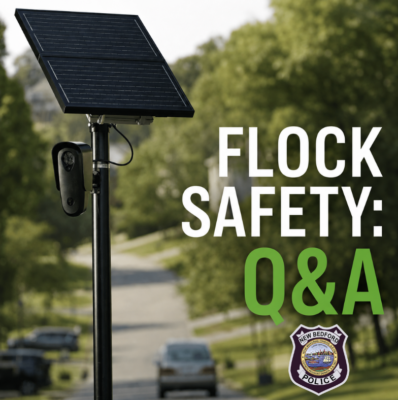 The New Bedford Police Department is committed to using technology responsibly to enhance public safety and assist in criminal investigations. We recognize that residents may have questions and concerns regarding privacy when it comes to these evolving technologies. Recently, there have been reports regarding Flock Safety’s privacy and information-sharing concerns. While Flock Safety has proven to be a valuable investigative tool, the department has implemented strict controls governing data sharing, access, and oversight to ensure the technology is used responsibly and is consistent with Massachusetts and Federal laws.
Q: What is Flock Safety?
A: Flock Safety is an automated license plate reader (LPR) system that captures images of license plates and basic vehicle information, such as a vehicle’s make, model, color, and other identifying characteristics. There are stand-alone sensors that capture still images to obtain this information, or the technology can be added to video cameras as an overlay. It is a tool that helps law enforcement investigate crimes, recover stolen vehicles, locate missing persons, and improve public safety.
Q: What concerns have people raised about Flock?
A: The most common concerns involve privacy and the possibility of tracking individuals’ movements. The NBPD takes these concerns seriously and has taken steps to make sure the system is used responsibly and in accordance with Massachusetts and Federal laws.
Q: What does the New Bedford Police Department use Flock for?
A: Flock Safety is used as an investigative tool to assist law enforcement in identifying vehicles involved in criminal activity and developing leads during investigations. To conduct a search in Flock, the officer or detective must indicate an approved law enforcement reason with the request. It is not used to monitor residents’ day-to-day activities or for any non-law enforcement purposes.
Q: What information does Flock collect?
A: Flock captures images of license plates and vehicle characteristics that are visible from public roads. It does not use facial recognition technology and is not designed to identify drivers or passengers.
Unless it is manually saved as part of a criminal investigation or other legitimate law enforcement purpose, data collected by the system is automatically deleted after 30 days.
The system also maintains an audit trail of user activity, allowing the department to review searches and system usage. This helps ensure accountability and allows the department to investigate any potential misuse of the technology.
Q: Who does New Bedford share information with?
A: Our system is set up to share information only with Massachusetts law enforcement agencies and law enforcement agencies located within 50 miles of New Bedford for legitimate law enforcement purposes.
Currently, New Bedford shares information with approximately 125 law enforcement organizations. Thirteen of those agencies are police departments within 50 miles that are in Rhode Island.
Q: Does New Bedford share information nationwide?
A: No, nationwide sharing is not enabled in our system.
Q: Does New Bedford share information with ICE or other federal agencies?
A: Federal sharing is disabled in our Flock system. Federal agencies, including U.S. Immigration and Customs Enforcement (ICE), do not have access to New Bedford’s Flock data.
Q: Why is information sharing important?
A: One of the primary purposes of Flock Safety is to facilitate the sharing of investigative information between law enforcement agencies. Criminal activity does not stop at municipal or state boundaries. Responsible information sharing allows agencies to work together more effectively, identify suspects, recover stolen property, locate missing people, and solve crimes more quickly. This collaboration is one of the key public safety benefits of the system. While we don’t openly share our Flock data to prevent abuse that could occur outside of our control, we will share this information with any legitimate law enforcement agency in relation to a criminal investigation.
Q: Has Flock Safety been effective in New Bedford?
A: Flock Safety has assisted the department in a variety of investigations, including homicides, robberies, shootings, stolen vehicle cases, breaking and entering incidents, vandalism cases, and missing person investigations.
The technology has helped investigators identify suspect vehicles, locate stolen vehicles, develop leads in violent crime investigations, and connect crimes occurring across multiple jurisdictions. In several cases, information obtained through Flock has contributed to arrests, the recovery of stolen property, and the issuance of criminal warrants.
Flock has also strengthened collaboration between New Bedford and surrounding law enforcement agencies by providing timely investigative information that may not have otherwise been available.
Q: Can you provide an example of how Flock has helped an investigation?
A: In March 2025, New Bedford Police investigated the homicide of Karina Martinez-Ortiz. After the suspect, Wilo Morales Colon, fled New Bedford, his vehicle was detected by a Flock camera outside of Springfield, Massachusetts. That information helped investigators locate Morales Colon and ultimately led to his arrest.
This case highlights one of the primary benefits of the Flock system: the ability for law enforcement agencies to share information and work together across jurisdictions. Criminal investigations often extend beyond the boundaries of a single city or town, and timely access to investigative information can be invaluable in identifying suspects and solving serious crimes. Several of our surrounding police departments also use Flock Safety.
Q: Can the department control who has access to its information?
A: Yes, we can determine which agencies can access shared information through the Flock system. We can approve, restrict, or revoke access, and we continually review those permissions to ensure they remain appropriate.
Q: Is this technology legal?
A: Courts have generally found that there is no reasonable expectation of privacy in a license plate displayed on a vehicle traveling on a public roadway. Courts have also upheld the use of LPR technology when used appropriately and in accordance with the law.
For example, in Schmidt v. City of Norfolk, a federal judge upheld the city’s use of LPR technology against a constitutional challenge. The department continues to monitor legal developments and follows applicable laws, guidance, and court decisions governing the use of this technology.
Q: How does the department balance public safety and privacy?
A: The department recognizes the importance of both public safety and privacy. Flock is one of many tools used to help solve crimes and protect the community. By limiting who we share information with, restricting access, maintaining an audit trail of system activity, and regularly reviewing our policies, we work to ensure the technology is used responsibly while protecting the privacy of the public.